Saturday, April 7, 2012

The Renewal of Pesach

For many years, my dad's synagogue had a great tradition of hosting different themed seders each year from around the world. Each time there were new insights into the variation of custom; one year there was honey date haroset, during another slings were placed over the children's shoulders to represent the hardship of slavery, and during yet another an orange was placed on the table to represent feminism. The families of the congregation join together for a new experience intermingled with the traditions they are used to from their own seders and learn about how Jews all over the world celebrate this meaningful holiday. For most, the experience of these seders are unique and eye-opening, they give a glimpse into a new way of interpreting the same thousands of years old story, and people come away from it with the small insight of a different kind of celebration. And isn't that what Pesach is all about? The challenge to ask "why is this night different from all other nights" and the opportunity to put forth our questions and reevaluate what it means to be a Jew and never forget that once we were slaves in Egypt and then we were freed.

I have been abnormally lucky throughout my life that this experience of the "other" Pesach has luckily been closer to my norm. Every other year or so my family travels to Israel to join my Ima's relatives for their form of Pesach, and each time we are together in Israel, I can't help but compare it to what I am used to back home. The family over here is large and diverse and every other year they switch between my uncle and aunt's house, where they host a seder closer to the kibbutz experience of their childhood, and my aunt's brother's home, where they hold their unique version of an Iraqi seder. At my uncle and aunt's the defining features are my uncle's salted fish, which is actually my great-grandmother's salted fish, which he buys from the same butcher where my Savta (grandmother) bought them decades before. It is full of tiny, tiny bones I have learned over the years to pick through and while I will never be an expert like my cousins on this side of the ocean, I think I can say that I have certainly improved over time. The fish is cut into spheres of delicious, cold, jelly and carrot-topped goodness that we dip into a shock of red horseradish and wash down with dry Israeli wine. My family also always comes up with an interesting twist, always asking each participant to think of something new. One year we were each to go around and talk about our favorite line from the Hagaddah and what it means to us. Another year we were given pieces of paper to write what we want to renew for the coming year, during this spring and harvest. And always there is the song of the children from the wheat fields, where they go to pick the first harvest and dance with the wheat stalks, always there is a speech from my Saba, always there is incredible food on a beautifully decorated table filled with family heirlooms from the 1700's from the Warburg side, and it always culminates in my uncle leading the way into hours of song, red-faced and eye-squinted as his beautiful baritone trembles through the air. The guests of this kibbutz seder had all been in the kibbutz choir in their childhood and thus beautiful harmonies float about.


Flowers of Petra
And then in America, of course, we have the traditional mixture of an English and Hebrew Hagaddah, where my wise grandfather leads the formalities and makes sure to highlight my Ima singing a song about spring, my Daddy giving a short d'var, my cousins "performing" the ten commandments from a kit of jumping plastic frogs, a push-button dying cow, red dye for blood, and fake hail among other things. We all search for the afikoman and all the grandchildren get a prize regardless of who finds it, and at the end of the evening, we open the door for Elijah. The best story is of one year when my grandfather somehow managed to arrange a hole in the table and Elijah's cup and hid under the table with a straw as me and the rest of the kids went to open the door. When we were back, we watched with awe as the wine was miraculously drained from the cup. Elijah must have actually visited! I wonder always how my grandfather got away with drilling holes, especially under my grandmother's watchful eye.

The way I've always imagined the burning bush...
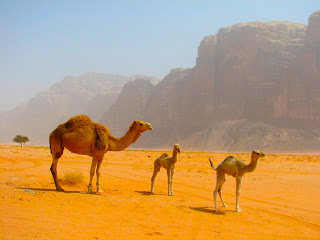
But back to Israel and the flip-flop between the Kibbutz way and the Iraqi way. This year, we went to Iraq. My pesach journey began this year, however, a week before when my brother and I visited Petra and Wadi Rum in Jordan. There, among other ancient red-glazed relics carved into the blazing azure sand, we also passed the site where the Bedouins explained that Moses stood and hit the rock. This was especially meaningful to me because it also happened to be my Torah portion from my Bat-Mitzvah. But it was more than that. Walking barefoot on the ancient sands, and sleeping in a bedouin tent under the stars and surrounded by sparsely shrubbed cliffs and huddles of camels, I felt I could picture how Moses had lived his life during his 40 years in exile. I could also, when surrounded by the breathtaking majestic of this open-aired, vast-skied, magnitude of nature, understand what had inspired Moses to be able to recognize the holiness of the burning bush. My visit to Jordan was memorable and interesting, but nonetheless, boy was I happy to be back on Israeli soil where I felt most safe. So I could also appreciate, albeit minimally, the celebration of reaching the holy land (for me, once again). 


Petra

Me in the bedouin tent

Jordanian camels
Wadi Rum


This year's Iraqi Seder
And then there was the moon. Big and bright and white and glorious, rise above and winking at us over flowered golden hills of wheat. Just like every Jewish holiday, the harvest came exactly in line with the cycle of the seasons, shooting up the most breathtaking harvest moon up above us to greet this new spring. I marveled at it through the car window on our way to Carmel Yosef and to join this other side of the family to celebrate this year's seder. We sat around a u-shaped array of banquet tables with more than fifty people buzzing with the energy of the celebration. We began by coming inside and leaving the moon to peek through our windows, and then, with my aunt's brother's booming voice leading the way, we watched as the children brought in the omer (wheat) and did a special dance, sang Ma Nishtanah, and went around and read the timeless story. There were also fun Iraqi customs. Anyone who wanted to eat an egg had to bang their heads against the wall in order to symbolize the suffering of the Egyptians during the plagues. My cousin and her cousin's cousin played on the flute and guitar and everyone sand loudly, swaying and smiling. And at the end of the seder, each child and grandchild approached the matriarch of the family, who sat in the middle of the room with a basket of walnuts, and sang her a song about spring in order to receive the blessing of her walnuts. She sat proud and smiling as each one, young and old, approached to get their share. Interspersed throughout, people had been asked to interpret for themselves the line, "וְהִגַּדְתָּ לְבִנְךָ," "And thou shalt tell thy son in that day," what it means to them and to speak to their children about it. This led to pockets of beautiful words and wise advice, as we went around and the parents blessed their children. When my father rose and spoke to me and everyone about how he thinks that Pesach is all about asking questions, it led on to an even more interesting discussion.


Bringing of the omer
Family heirlooms

Ma Nishtanah
More heirlooms from the 1700's


Hitting my head against the wall for an egg...

Success!!

The date and honey haroset is in the bowl, hillel sandwhich on the matzah

Our family's famous salted fish

With my adorable cousin

My incredible parents


My Ima with her walnuts!


Singing for walnuts

Today we had lunch with more of my uncle's salted fish in my Saba's  (grandfather's) home back on the kibbutz, where my aunt asked why we celebrate a story that happened thousands of years ago. We're still here, aren't we, she affirmed, so what is the point? Each of us has to interpret our own meaning of this beautiful holiday, but I think my father's answer was both eloquent and worth sharing:

We read that once we were slaves in Egypt and now we are freed. But really, in each of our own lives, we find ourselves enslaved to many things. They can be petty, like our cell phones, or larger, like an addiction, and most of us our enslaved to much more than just one thing. But during this time when we reflect on how we were freed and are encouraged to ask questions, it is also the harvest, the holiday of spring, and the time of renewal. May we all, in each of our own ways, find the strength to partake in the real work in the spring of renewal in our own lives now that the seder has passed. May we, as my father said, aim to be more like the modest, simple, plain matzah and less like the pretentious, bloated, and bitterness that can come from chametz, and find for each of us, a path of strength, beauty, celebration, and renewal.

Yetziat Mitzraim

Doing it Kibbutz Style

On the kibbutz, families and children don't just do the average, they go all out with their celebrations. During the week leading up to Passover, there is a tumble and a buzz flying through every Jewish home as everyone cleans out the cubbards and sweeps each corner to prepare for the holiday. And the kids partake in projects, sing songs, and share all they know. Each community has their own unique brand of festivities and everywhere, children learn about their history. I had the pleasure this year to partake in a time-honored tradition on my family's kibbutz that was begun by my cousin's grandmother, Hava (who is now 100 years old, still making ceramic statues, walking on her own, and going strong), where they reenact the Passover story to the tune of fun activities, dances, small nuggets of a narrated play, and all-around good fun.

Take a look and follow along with the story with me:


First we greet Moses, from Mount Nebo, where his story ended, overlooking the holy land of milk and honey. He waits with his loudspeaker from the top of the ancient stoop to tell his story.

It begins with the dance of Pharoah's daughters by the Nile...


The steps of the community dining hall morph into the Nile


Moses floating on the fish pond


We continue our story with the discovery of the baby Moses when his mother sent him down the Nile in hope of his rescue. Little did she know he would be found by a Princess.

The adopted son of Pharaoh witnesses many hardships that the slaves must endure. He gets so angry when he sees a taskmaster mistreating a Hebrew slave that he attacks and murders him. He must run away to the desert.


The central hill of the kibbutz is transformed into the brick and mortar reality of the Hebrews


After 40 years of peace and quiet in the desert, Moses sees a miraculous sight. A bush he has passed by hundreds of times is suddenly burning with fire! God tells him he has been chosen to tell Pharaoh to let his people go.


We go with Moses to the cow ranch, "Pharaoh's kingdom," to tell him to free the slaves. There are many plagues that the Egyptians face when Pharaoh's heart is hardened, including hail, coming from water guns. Quick! Run through!


Pharaoh finally lets the Israelites go.  They escape through the desert carrying bread to bake on their backs. They run through the miracle of the parted Sea of Reeds (and escape the stream of a huge hose!)


The Hebrews wander through the desert for 40 years. They ask for water and Moses gets angry and hits a rock instead of asking it for water. It finally comes in the form of Tropicana foil-wrapped juices. The people continue to bicker and complain. They need food. The miracle of mana falls from the sky, in the form of the popular Israeli treat bamba, straight from a crane that towers in front of the kibbutz dining hall and theater. Wow, God is really easy to spot in this version!


And then comes the miracle of the ten commandments. The children of Israel dance for joy!

My two cousins are in the flowered light blue turquoise and black


Dance performed by the children of the kibbutz
 And the most amazing part is that this has been going on since 1949!


Me pointing to my Savta (grandmother) singing in the first kibbutz choir


A close-up of my Savta, age 24


In the 80's the tradition continued with my cousin, in pink, and my uncle in white on the far right


And we shall teach our children so that we may never forget that we were once slaves in Egypt and then freed...

My amazing cousin Noam, age 9
Celebrating pesach through the years...


My sweetheart cousin Amit, age 6, in blue

 Whereas in America we work so hard to infuse our children's experience with bubbles of Jewish learning and knowledge, here in Israel the history of the Jewish people is part of the normal cycle of events. Mana comes in the form of marshmallows and bamba. Moses in a curly grey beard standing on a hill in a garden. Everyone knows the words to every Passover song. "Simcha raba, simcha raba, aviv heegeya, Pesach ba..." Reenacting the hardships of slavery with the pulling of a farm cart. And the smiling, dancing children. We are so blessed to have this land that is so much more than milk and honey. It is the land of hope.

Happy Pesach to all!

Friday, April 6, 2012

Ashalim: ART V

Part One

Colors, colors, and more colors! We are in the midst of exploring the world through rainbow-colored lenses. Our first lesson was on the primary and secondary colors. Our goal was to paint a picture by using the colors red, yellow, and blue. We could create whatever we chose, the only rule was each painting must also include orange, purple, and green. The children explored with color and came up with beautiful designs. Check back to see what they learned next:

Using all of the colors of the rainbow.


Making sense of the primary and secondary colors.

Starting to think about complimentary colors


Mixing all of the right colors.
Using all we've learned about color, spot, space, and line.


Saturday, March 24, 2012

144 Languages, Nations, and Faces

Dream box
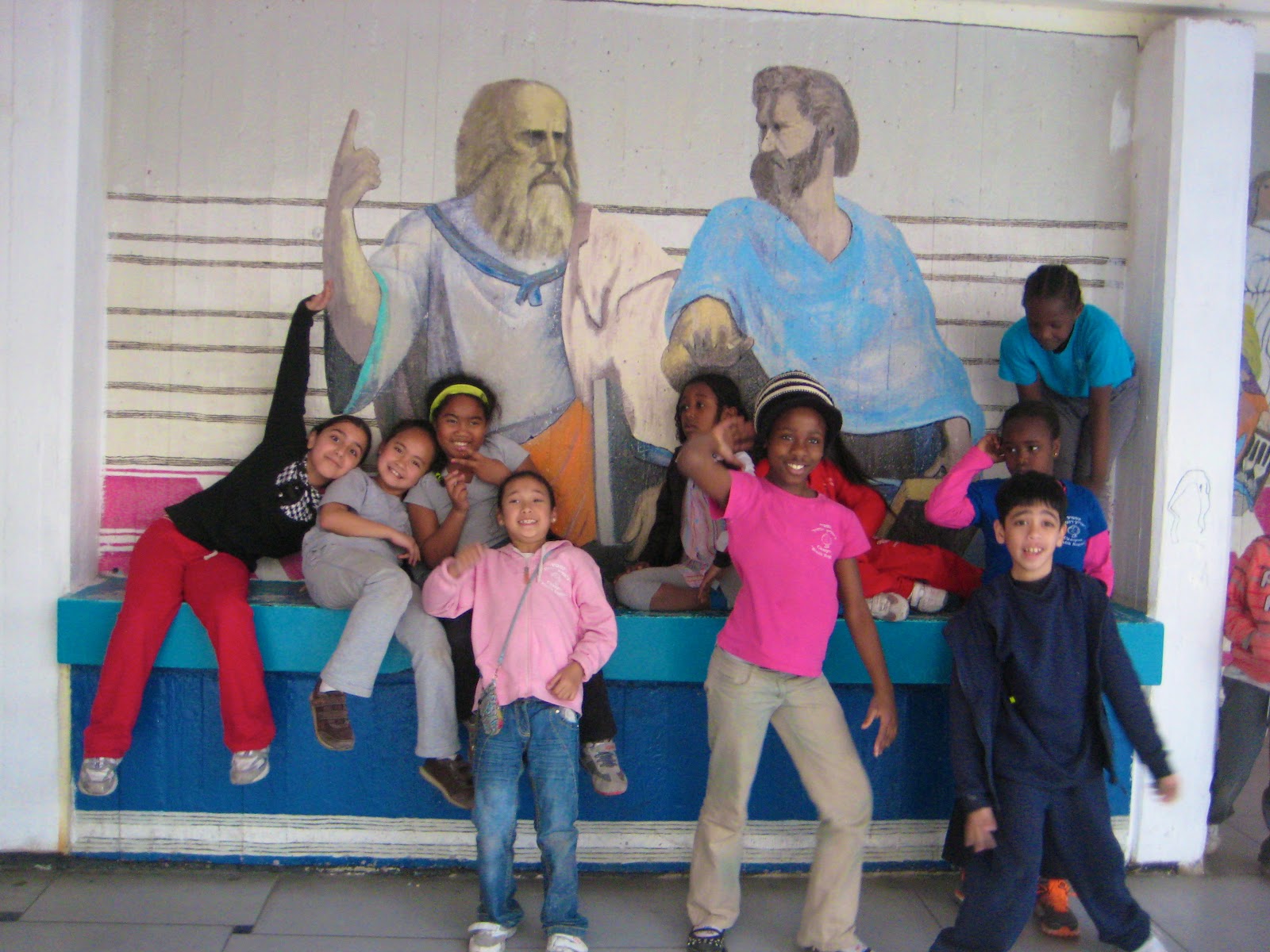
A week ago I had the pleasure of joining a group from PURSUE on part of their trip to Israel. For my part, I was in charge along with my fellow fantastic teacher in crime, Alyssa, of leading two art projects with the trip volunteers and the children in a very special school in southern Tel Aviv. This school is no ordinary school. Housed in the Hatikva neighborhood, the Yarden School has gone through a fascinating transformation. When it first opened about 60 years ago, it was a school for Israeli children. Now, following the Russian immigration of the 90's and the most recent influx of African refugees, asylum seekers, and foreign workers, the school serves quite a different population.

More dream boxes
Walking through the hallways of the school one could easily hear a minimum of four languages twirl through the air. Looking upon the faces of the children and one sees tan, toffee, dark chocolate, ebony and all the shades of skin that come in between. There are Filipinos and children from Ghana, Sudanese and Eritreans, Japanese, Russians, and more. Each of the children has a unique story of how they came to be there. And while for the past few years these children have had to endure  protests as they come to school each day, yelling for them to return to where they came from (ignoring the fact that many were born in Israel and only had the bad luck to be considered "other" by virtue of their parents' story) the beauty of this school is that once they enter the doors, none of that matters. All that matters is helping anyone who arrives at their doorstep.

Decorating
Writing notes
The first day we met the a group of 25 2nd grade students who were part of a special extended day program much like the moadoniyot that I work at in Jerusalem. Alyssa and I gathered the children and Pursue participants in a circle and asked the children what their dreams are. One little girl said a doctor. Another said a hairdresser. Still another said a teacher. And the ultimate dream? To be in the army. Only then will they be considered true Israelis. As the short talk commenced, English, Filipino, Russian, and Hebrew intermingled and I watched as one little girl from Ghana leaned against her best friend from Ethiopia. Here they were just friends, nothing more. We decorated boxes to hold their greatest possessions and in which they could hold their dreams.

Finished boxes filled with notes
There was great fun and laughter as we all worked together on a plastic tarp under the Israeli sun painting, gluing down decorations, laughing and talking. And then each adult wrote a special note for each child to keep. They jumped, clapped, and squeeled as they placed their precious well-wishes into their boxes for safe keeping. One little boy hugged three boxes to his chest, beaming ear to ear. At the end of the session I told the children that this is just the beginning of a place for them to think about their great potential and the opportunities of the future. Some of the little ones pulled me into a slanted group hug thanking me for their boxes of dreams. For many of these children their fate remains unknown. Some may be sent back to their troubled countries and others will stay here struggling to integrate into Israeli society.

Final touches
I left the children and their dream boxes with mixed feelings. On one hand, I thought about how proud I was that there are schools like this that do everything and anything to help these children, that they represent the true meaning of love and gemilut chassadim to me. On the other, the reality of what may happen to these children and their families down the road, and what has already happened to bring them here both alarms and disheartens me. Like one of the little girls said to me, "why we cannot all just get along, like us here together."

Another finished box


The pep rally/soccer/basketball game
The second day began with an inspirational tour at the Bialik-Rogozin school, made famous by the Academy Award Winning documentary, Strangers No More. Because of the publicity they have received since the movie, there are one of the four places in the world to have a special Google Maps interactive touch screen station and every child at the school was given a chance to enter and zoom into the street level view of their family's hometown. We took a tour of the school, went to a kindergarten, watched a music class of swaying children, and the end of what seemed like a soccer game and basketball game simultaneously happening on the same court, to the backdrop of a huge, colorful pep rally. The same issues as the other school exist here, but like the other, once the children enter these doors, they are just children who deserve all the love, education, and kindness of any other. My favorite site was watching children of all different nationalities gather around a bulletin board of gorgeous Purim masks.
People waiting in line to try out Google World

Purim Masks
Interesting mural at Bialik
After our visit at Bialik we returned to the Yarden School from the day before to take part in another project with a group of 40 first graders. Before the project we had the chance to play with the children in kindergarten out on the sand-filled playground. I keeled over with laughter as Jimmy, one of the JSC fellows who happens to be very tall, was immediately jumped on by an adorable African boy. Jumped is probably the wrong word; it was more like the child saw him, broke into a run, and catapulted himself onto Jimmy's shoulders. After that, there was no way to stop it. I watched as children of all different shades and nationalities piled up into the air and sprung at him from every direction. And then it was my turn. I felt a confident tap on the shoulder and before I knew it the most adorable little girl sprung up into my arms. She had soft, flowing braids tied up into a ponytail and a laugh that made me want to squeeze her and take her home with me. Her name was similar to mine, just a few letters' difference, and her Hebrew was laced with an incredible African accent. She wouldn't let me go, even when I was being pulled away by two more little ones.


Day 2's Project
The dichotomy between present and future realities of these precious children is almost too much for me to bear. They are sweet and bursting with possibility and have come from struggles that we cannot understand. The existence of these schools makes me proud to be an Israeli and a Jew. But this doesn't fix the overall situation.
Decorations for spring


I was surrounded by 144 languages, nations, and faces that day. It changes the face of Israel as we know it. But it is Israel nonetheless, and when a little girl from Eritrea ran up to show me the Jewish star painted on her arm, I was able to see it firsthand.