Friday, March 23, 2012

Ashalim: ART IV

This week, we learned about Ernst and the process of frottage, where textured objects are placed beneath paper and used to represent an image. Once again, I was very impressed by the gorgeous results!:

Warming up with leaf rubbings


More leaves

We checked out materials at hand and then planned our landscapes.

We used all different textures to represent the things we wanted.


The final products in one moadonit!

The kids at the second moadonit practice with leaves.


Focusing on the subject of the composition...
Adding to the negative space, or background, and remembering all we've learned about line, texture, space, and composition. The finished product? Dazzling. And all created by a nine year old girl.

Do you see the faint leaf print fish in the background? When I asked him about why he didn't make them darker, he said they were in the distance, so he kept them lighter. I was so excited about his grasp of perspective! We used different textures to create the illusion of moving water, scales, and seaweed.

Close up of the finished board in the second moadonit.
This week and last week's work. The kids were very excited and so was I!

Wednesday, March 14, 2012

Ashalim: ART III

This week, we learned about a new type of art from the far east. We looked at photographs of Japan's cherry blossom trees and talked about the ancient history of Japanese ink painting. Then we made Japanese Sakura paintings by applying a small spot of watered down black paint to a piece of paper and blowing with a straw. The beauty of it is that we don't get to choose where the paint will go; the paper and the paint direct us. The children had to come to terms that they couldn't control everything and had to just go with the flow. They also had to deal with turning a "mistake" into part of the composition. And what we come out with are incredible trees. We talked about painting real branches instead of the typical "lollipop tree" (anyone who went to elementary school with me will know what I'm referring to!) and how we can use line to create the winding patterns you see below. The more paint, the thicker the line, the less paint the thinner the line and more of a likelihood that there will be a splitting off effect. We also discussed how Japanese art typically hints at the whole picture by showing one aspect of an object that is cut off at the edge of the page. The children experimented by adding spots of paint and adding layers upon layers of intricate lines. Then they made balls of tissue paper and glued them down to capture the blossoms.

The best part was that there was a child from the moadonit whose parents are from Japan and he explained the culture of Japanese tree painting, cherry blossoms, and different festivals to the other children!

Check out the gorgeous work products:


The paint is watered down and goes where it wants


Adding cherry blossoms

The work in action


The finished product!


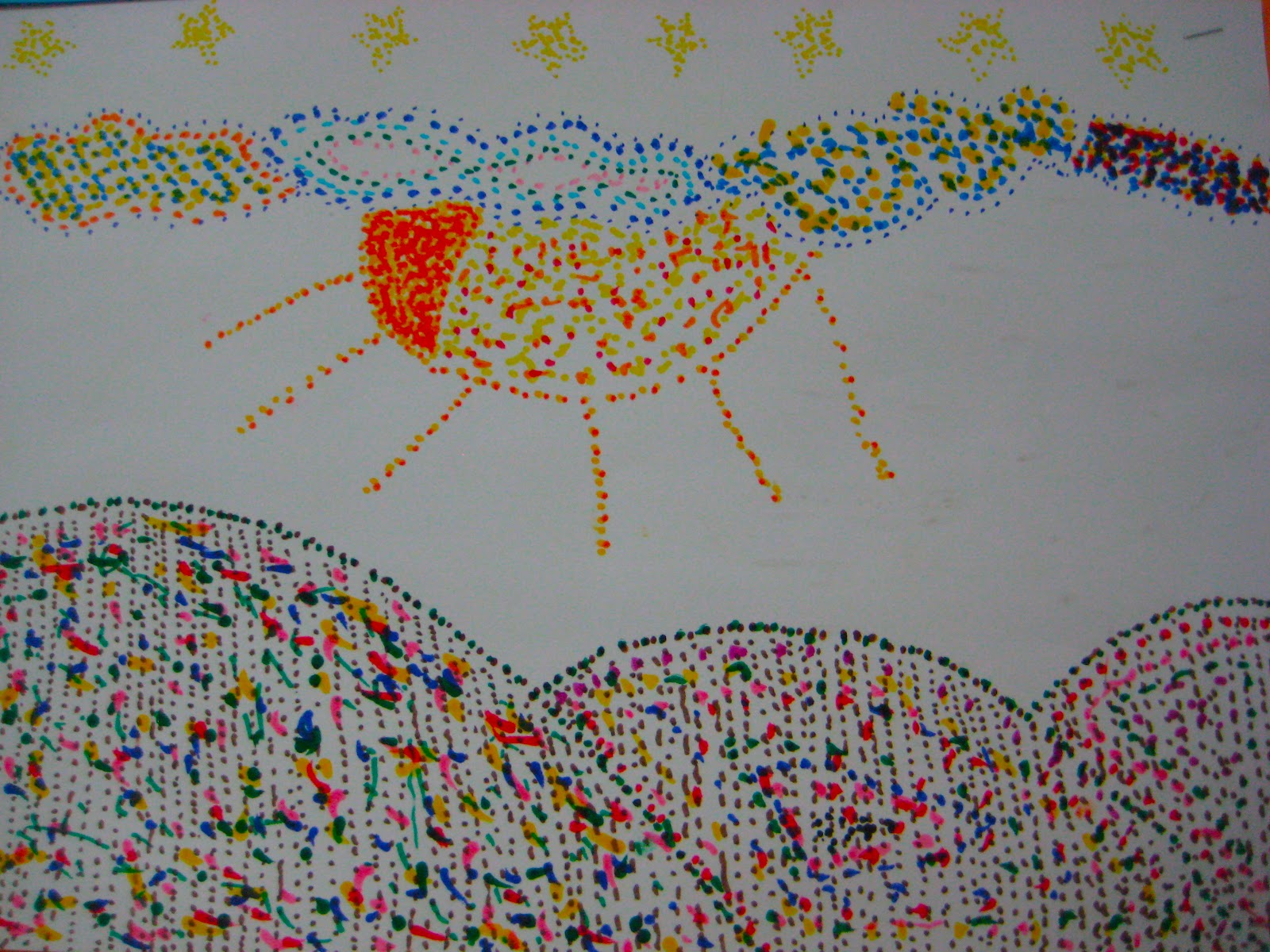
After the project, the kids went back to finish the pointillism landscapes they had begun weeks before. They enjoyed it so much that they have been taking their time to fill their pages with thoughtful, colorful dots. Here, we learned about patience, color, density of the dots to create spots of light and shadow, and composition. We learned that things can be represented in many different ways and that the space, volume, and substance can be captured with color just as much as the typical lines and shading in they are used to. They had to plan ahead about what color they wanted to stand out in each section but also take into account all the other colors that could add to the effect of the piece. They did a great job and love it so much that some even began a second piece!

I am SO proud of them and their finished work! These children are 6 to 9 years old and just look at the gorgeous artwork they have produced:

Before

And after!!! Drawn by a SEVEN year old!!!!

Our finished display


Look at the bands of shadow!

Great choice of color!


A close up of the sky and sun
 And there are still more to come....


Monday, March 12, 2012

Mishloach Manot: What It Means To Give

Making masks
Flowers from the kids
I was recently at a Purim Seudah where one of the guests gave an interesting drasha on the significance of the word melech, or king in the megillah. He said that although the name of God does not explicitly appear, the word melech does many times. In that way, and through many other phrases, such as yavo for "he will come" and different literary devices, the name of God is in fact there, just hidden. He highlighted this to point out that maybe the hidden presence of God allows each one of us to shine as kings on this one day. In part, the job of a king is to drink and be merry and to revel in the wealth all around, which we all seem to do very well on Purim. But the other side is much deeper. It is the responsibility of the king to care for his people. As part of this concept, I have been reflecting a lot about the meaning of mishloach manot, mutual gifts of food and drink, and mattanot la-evyonim, charity to the poor in light of my recent experiences with the children at one of the moadoniyot where I work.

Last Tuesday I joined the children of Moadonit Afikim to go on a very special field trip. We painted each rosy face green for a witch and with the large cartoon mouth of a clown, with the long lashes of a princess and the triangular goatee of a pirate then headed off into the neighborhood armed with colorful totes full of fun ready-to-eat treats. It was hot and at first we couldn't find the building complex we were visiting and two of the children were complaining about their shoes. When we got there we were startled by two cats in a screeching fight and the doorway to the first apartment reeked from the smell of urine and spoiling garbage. The children threw their hands up in disgust and we showed them how to breath through their mouths and respect the people of the building by not complaining. We were there to give small presents of food and Purim decorations and to say chag Purim sameach to each of the elderly men and women we were about to meet.

Painting our masks
The children of the moadonit are always bickering, arguing and complaining. They have to be constantly be reminded to be grateful and thankful for the things we provide them and not to ruffle their noses at the color or flavor of a special candy we reward them with. We are always talking to them about using kind words and actions, for caring for others, and doing their best. Yet each day is a constant battle when combating so many external factors like their difficult home lives, poor backgrounds, emotional problems, anxiety, fear, anger, and for some, abuse.

But that Tuesday the kids forgot to be sad, accusatory, and to bicker the moment the first door at the first apartment opened. We sang out a cheery happy Purim and walked into a cozy, sunlit living room and piled onto to dusty sofas. One of the children held out a bag of mishloach manot and was immediately smothered by the old woman's excited hug. All around us were framed pictures of family and the woman greeted us with a smile so happy it could break your heart. Then, in a broken Hebrew laced with traces of the Spanish of her Argentinian upbringing, the old women began to make up an elaborate story full of color, laughter, and many different character voices. The children chuckled and smiled shyly as the woman's face stretched into silly expressions and she threw her chin up into the air with an animated chortle. She grabbed each of their cheeks as we filed out and thanked us for making her day.

The finished masks, peeled straight from their faces!
The next apartment was that of a cancer patient, ringing of the smell of medicine and cobwebs. The room was dark and cramped and at first the children were scared. But then we decided to sing a Purim song, which lifted the old woman temporarily out of her suffering to the point where she pushed herself away from her walker and joyously spun two of the children round and round. "I used to dream of being a ballerina, you know," she told them. "Thank you, thank you for reminding me."Another child handed her his mishloach manot and was also wrapped up in a hug.

At the third apartment, we sat and drank mitz petel, a popular Israeli children's drink and picked through candies as the grateful woman looked through her mishloach manot bag. "No one has ever brought me anything like this," she whispered over the din of an Israeli soap opera on the TV. Then she said something in Russian and one of the children's ears perked up. We discovered that the woman knew the little girl's mother and they exchanged a few excited words in Russian. We talked a bit about her childhood in Russia and ate a few more treats and then sang another song before saying good bye.

The fourth apartment was brimming with colorful paintings of large towering ghostlike figures, the scene of a village from way-back-when complete with a mule and cart, and another lovely sketch of the hills of Jerusalem. Peculiar cigar-thin hamentaschen were baking in the oven and there were pictures stacked between every painting. I was sitting on a rocker with one of the children cozily sitting on my lap when the madrichah of the moadonit asked the woman what her favorite Purim costume growing up had been. "Costume!?" the woman frustratingly exclaimed, "from what did we have time to wear Purim costumes? By the time I was eight I was an orphan of the Holocaust; I watched my parents and my brothers and sisters get loaded onto the death train and then I was alone. We didn't have time for costumes." she spit out. One of the little ones leaned forward with wide eyes. "What was the death train?" she whispered. The woman twisted the handle of her mishloach manot as she explained to the children about the way the Jews were packed into small, dark trains like sardines, into a box with no air or light, no water or food for eight days straight. How they rode back and forth on the rails until the people died, and the people who were still alive were then thrown into a deep ditch and shot. The children wanted to know how people could do that to other people. One little boy said because there are some evil people in the world. Another girl, who usually spends her days bullying this same boy, squeezed a hand on his shoulder and said, well, don't worry you're safe here. Then we went around and discovered the rainbow of nations that were represented in that one living room: the woman was from Romania. I am from the United States. Their wonderful, beautiful, energetic madrichah is from Yemen. And the children are each from a different place--Ethiopia, India, Russia, Ukraine, France, and Japan. They all went around and said hello in their native language. The woman hugged each of us with tears in her eyes. "You are all wearing lovely costumes," she said as we left.

That day our mishloach manot cheered the lives of the old, alone, and sick in a poor, disheveled neighborhood block. But what it did for us and the children was so much more. There are many explanations about the significance of this Purim law. We give mutual gifts of food and drink in order to bring us closer to one another, to help the poor without making them feel embarrassed, and interestingly, in contrary to our normal interpretations of charity where the highest form is from an anonymous giver seeking no reward, the mitzvah of mishloach manot may only be fulfilled if the giver is known so that a bond of friendship may be formed. But I think that the children's mishloach manot went far deeper than that. They reminded them of what they have. They taught them what it means to give unto others, to listen and learn, to appreciate, be humble and thankful. At the end of the trip, I would have liked to be able to say that the children walked back hand in hand, laughing and sharing candies and smiling. Instead, they snapped back into their default modes of bickering and complaining, but when we got back and shared our experiences with the second group, I saw the joy of their experience swing around the circle once again.

We spent the rest of our day creating beautiful masks by layering pieces of wet plaster on one another's faces, working together and waiting for them to harden, peeling them off, then painting them in bright, dancing colors. In the spirit of Purim, we had masks to hide our faces to symbolize how God worked from behind the scenes to manifest the miracle of the Jew's survival on that day in the month of Adar. So we also wore masks to remember the inner workings and the beauty of the small miracles that can happen every day, especially watching a child experience the divine gift of giving.


Some pictures from my own Purim celebrating:
A puppet show on Ben Yehuda
Me and Orly with a wind-up doll


A real life talking flower!


The tree was very happy to be photographed


Fun in the sun at a street party

Tuesday, March 6, 2012

Ashalim: Purim Fun

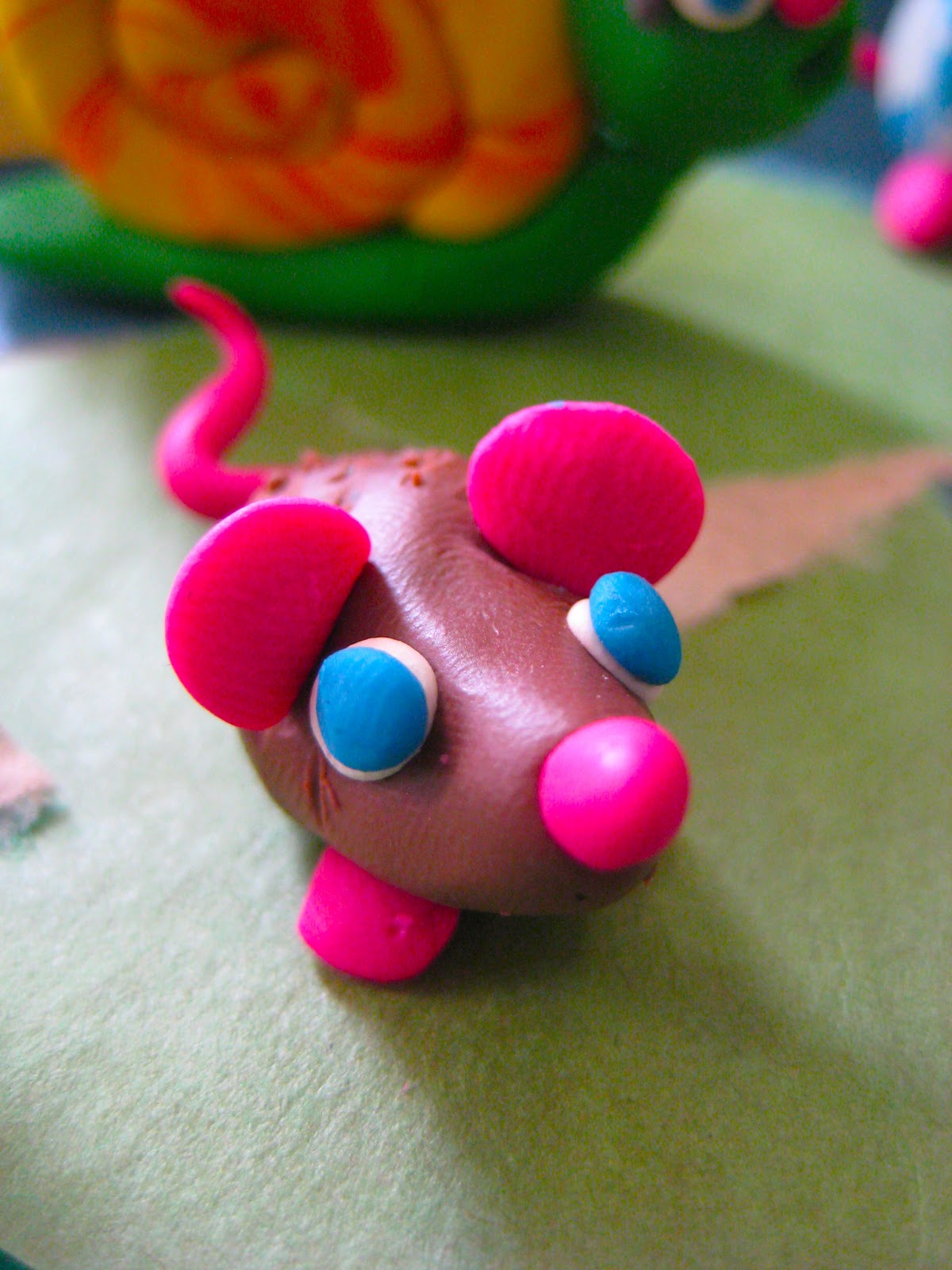
Clay Animal Project
 As with every holiday I've experienced in Israel so far, I continue to be overjoyed by the energy that is EVERYWHERE as everyone prepares for the next festival, this one being Purim!

I have to admit, I'm not sure why but Purim, despite all of the exciting activities surrounding it, has never been my favorite holiday. There were of course some lovely aspects to it. Growing up, I adored being in the Purim Play with the choir every year and like every little girl dreamed of the day I would get to play the coveted role of Queen Ester, which I finally did in our rendition of "Rockin Shushan" where Ester's Achashverosh was Elvis and Vashti sang "It's My Party and I'll Cry If I Want To." The narrators were "Rockettes" and we all wore poodle skirts with records glued to them. For my part, I got to sing "Downtown" but instead of those words, we sang "Shushan." It was always loads of fun.

I also used to LOVE watching my Dad dress up in a crazy costume and recite an-ever hilarious rendition of the Megillah. He would get up there with the Cantor and the other Rabbi and they would put on quite a show. I'm always proud of my father, but during those readings I was always especially grinning from ear to ear.  And then there was the carnival, the day every child at temple looked forward to- full of fun booths and games and candy and costumes. When I got older I ended up running the booths, usually opting to do the face painting.

My Little Snail Guy
But for some reason, despite all those whimsical happenings, I never really looked forward to it. I really couldn't tell you why. My only theory is that maybe Purim was so separate from the modern world I lived in, all the festivities being held only at synagogue, and the only sign of it in the stores being plastic boxed hamentaschen. All the other major holidays of the year were there for everyone to see: Rosh Hashanah and Yom Kippur had their own days off from school, Hanukah competed with Christmas commercialism, and Passover came and went with Easter. The other holidays in between, Sukkot, Tu B'Shevat, and the like also had less impact, but since they were seemingly more minor on the calendar, it never bothered me.  I think my problem was that I always felt like Purim was the odd guy out. "What do you mean you boo whenever you hear the name of the man with the pointy ears?" and "Why do you have triangular cookies?" and "What's a grogger?" and "You're dressing up as what?" always rang from my non-Jewish friend's mouths. I suppose that maybe the entire concept of the holiday simply seemed foreign. And it wasn't enough for me just to call it the Jewish Halloween.

A clown I drew for the carnival
When I grew up and moved to New York City, Purim took on a new effect. It was a fun party all over the Jewish stratosphere. There was always a huge, outlandish overpriced Dor Chadash party at some sceney place; last year's was complete with glittering gold-painted women on stilts, fire blowers, contortionists, and magicians. There are tons of Megillah Readings at every synagogue, especially on the Upper West Side, and people slink in and out in costumed packs. One of the synagogues transforms its sanctuary into a kind of disco party which is always stuffed, and conversely, tends to always be disconcerting to see couples grind against each other only a few steps from where the Torah is kept. So my adult experience of Purim was generally more fun, but still, it always felt like a random hiccup.

But here, the buzz of the celebration permeates on every street corner. For weeks, shops have been brimming with bedazzled costumes, and parties-a-plenty have been planned. All week long people have been going around town conducting their business from beneath a pirate's hat or a spiderman mask or in a tutu. My cousin's 8-year-old daughter baked her own cookies and wrote sweet notes to everyone in the family as misholoach manot, and talk of what costume each person will be has been spinning through the air. As I write this entry there is a colorful costume parade marching down the street outside my cafe window. There are drums, tons of kids in costume, streamers, music, banners, and a general feeling of celebration. And Purim is still two days away. The popular kid costumes these year seem to be mice, bear cubs, IDF soldiers, as always ninjas for the boys, and princesses for the girls. Some people got very creative too-- there's a huge papier-mache dragon floating on huge stilts, a clown car zigzagging its way through the crowd, and all sorts of kites and batons.

One of the most popular Purim costumes this season
My schedule of celebration is also popping with festivity. Here's the breakdown of my week (and these are only the things I chose to attend- a girl can't do everything!):

Tuesday night: hamentaschen making party (I'm in charge of bringing the nutella)

Wednesday night: huge block party in Tel Aviv

Thursday day: there is only a half-day at work, so we're going to probably walk around the city in costume and go in and out of different street festivals and parties

Thursday night: myriad parties all over Jerusalem, one being a 90's theme, another a disco in the shuk, another a trans festival that is only announced an hour before and will most likely be in the north or south of the country...

Friday morning: pancakes and megillah reading

One more cute picture of the finished project
I kid you not- it seems to me that everyone is taking the proclamation of "getting drunk and being merry" very, very seriously!

And at the moadoniyot we're also having a lot of fun. Today I'm joining the kids at one to deliver mishloach manot to the community, and in another I spent last night drawing and painting huge decorations (scroll down to see one of them, Simba from the Lion King, below) for a carnival that is happening all this week. At schools, each day of the week has been a different costume party: inside-out day, polka-dot day, pajama day, and of course the costumes, and it is no different at the moadoniyot. We've also been planning all sorts of fun crafty activities, including mask making, clay animals (the ones I made as examples are displayed here), and all sorts of fun Purim challenges.

It's very refreshing to be in a place where my culture, my people, my history is all around me at all times. Sure, the intensity of the place and the dichotomy between secular and religious communities can be at times a bit daunting, but all in all, this wonderful experience of hamentaschen in every window, costumes at every small shop, and posters advertising parties plastered all over the city has an exhilarating effect. For once in my life, MY culture is spilling through the seams of society, and it feels pretty good!


Pre-painting Simba that I drew for the moadonit Purim carnival


Simba completed! It was so much fun to paint again, I think I went a little overboard...

Happy Purim to all!