Tuesday, December 13, 2011

Ashalim: Changes in the Game

Today we gathered all the volunteers, teachers, and students of the Ma’aleh room together for a special “peilut” focusing on our emotions. It was the first time that we’d gathered all the children together in one room for a shared activity and it was a great success.

Suddenly, instead of fighting separately to help each teen along their course, we were working together as a group. Last week Moriya, the talented social worker who is in charge of this room, told them she was leaving after Hanukah for unfortunate personal reasons.

Drawing how we are feeling (notice a house)
 She is incredibly disappointed, disheartened, and saddened by her unexpected departure but because of political and economic reasons she has had to leave. This is a woman who came into the chaos of this place a year and a half ago and swept up the children who needed her most into what became their only safe space. Now she is leaving and suddenly the central person (in many cases the only person) who is truly there to listen to them, be there for them, understand them, and guide them will be gone.
Me and Moriya

Song for Moriya (How could I forget your face, how will I look in your eyes?)
This shared sadness has pulled the children together and sobered them. It has given them something to talk about. It is hard to stomach that this is what it took to begin making the first step towards community. This entire week the room has been suddenly transformed into a place of introspection and shared emotion—ironically the exact things that were missing up to now have suddenly begun to exist. All the volunteers, soldiers, teachers, and social workers who are involved in the room have been asked to be there to offer support. Instead of the cold, emptiness, anger, confusion, and mayhem, there is the semblance of a sudden family.

Before: shouting, yelling, constant cursing, the teenagers pulling each other down and using words and fists to further pound in their anger against one another. The message: You are hurting so you will hurt others. You will get away with fooling around because no one is really noticing you. No one is really paying any attention.  

Now: as I sit here writing, two of the most troubled boys are sitting quietly together on the couch sharing a game with each other. They are bending over an iphone and whispering advice and help, talking casually, and working together. Earlier, we went around the circle and shared how we are feeling and what the activity was like for us. Moriya spoke about how proud she was of each child who participated. She invited them to continue to use this room all week to work through the difficult emotions they are feeling because of her departure. Teens said they were scared, sad, worried about who will replace her. They said they know it will never be there same. The message: You are hurting but it is OK. We are all hurting and this is a safe space to express our emotions, together and apart. Sometimes you still hurt others and you hold fast to the patterns and actions you are used to, but we are all in it together and it can get better.
 
Before: a fragmented daily and weekly schedule when teens who weren’t meant to be there stream in and out and the ones who had scheduled sessions never showing up. The teachers and volunteers fruitlessly calling them and searching for them in the hallways. By the time they find them (if they succeed in that) the time is almost over. Meanwhile, the teens are either wandering the hallways, getting into fights, or coming in here when it is not their time just to try to get out of class. There is more yelling, fighting, throwing, cursing, disrespect. The adults are running around searching and trying to control the whirlwind of turmoil that exists. The message: There is nowhere for you and no one really cares. You are told to do one thing but there are no real consequences if you don’t.
The teen's drawings

Now: all the children came at ten in the morning, sat together in a circle and participated in a shared activity. All of the tzevet was there and the room was filled with an aura of support and understanding. Each child had one or two volunteers sitting and working with them, discussing their emotions, what they can accomplish, and reflecting on what they have already succeeded in changing in themselves. After they were finished they were instructed to draw their emotions, filing the entire page with color. The message: There is somewhere for you and it is here. The strength doesn’t come from just Moriya (although she has done a lot for this place), the strength, rather, comes from each of you. When we work together seriously, committed, and reflect, we can make real gains.

Before: a dump zone where teachers and principals throw the “troubled” kid into the room, often without a purpose or assignment, simply to get them out of their hair. Sending them home is more problematic because of what may await them there, so instead they are thrown in here and told to stay put. They are told to sit quietly and not bother anyone. Students doing anything and everything to try to get out of class discover just how easy it is—just wear a certain sweatshirt instead of what you are told and “wallah!” you are made to sit in the Ma’aleh room all day long with no responsibility or work. The message: You are unwanted everywhere. You are a menace. You are nothing. It is easy for us to dismiss you without feeling.

Now: next week we will have a Hanukah party. Two of the teens have taken charge of collecting the money from each student and teacher. Others have said they will prepare a special treat. Everyone is excited to be together. We will eat, create an art project and celebrate the miracle of the eight lights The message:  You are part of a community. You are wanted. You are responsible for this community. You are important. We still have a lot of work to do, but we are getting closer and closer to our goal each day. 

This place is by no means fixed. Rather, on the contrary—I am apprehensive and bothered by what this big transition might mean for these children. I think that there are a lot of problems in the system, in this school, from many of the teachers and leaders that are supposed to be there for the kids but are instead doing everything to continue to beat these kids down.

There are things that are impossible to fix quickly with one person, one room, some well-meaning people.  There are some things that may never be fixed: lazy, angry, sad people who do not deserve to call themselves educators, poverty, broken families, the streets, overwhelmed school leaders, a system without enough money, laws and regulations and decisions that are made because of political reasons instead of what is good for the children…
These are things that could change slowly, surely, along the long run if some serious decisions are made, but for now, all we can do is try to make small tiptoes forward. Tiny, little gains in even one child’s life makes it worth-it. I don’t know what will happen next or if this sudden community feel will last. But at the end of the meeting, when some of the girls and I took silly pictures together and then they thanked us for the activity, I knew we were starting to move in the right direction. 

Saturday, November 26, 2011

Ashalim: We Are All Children

 
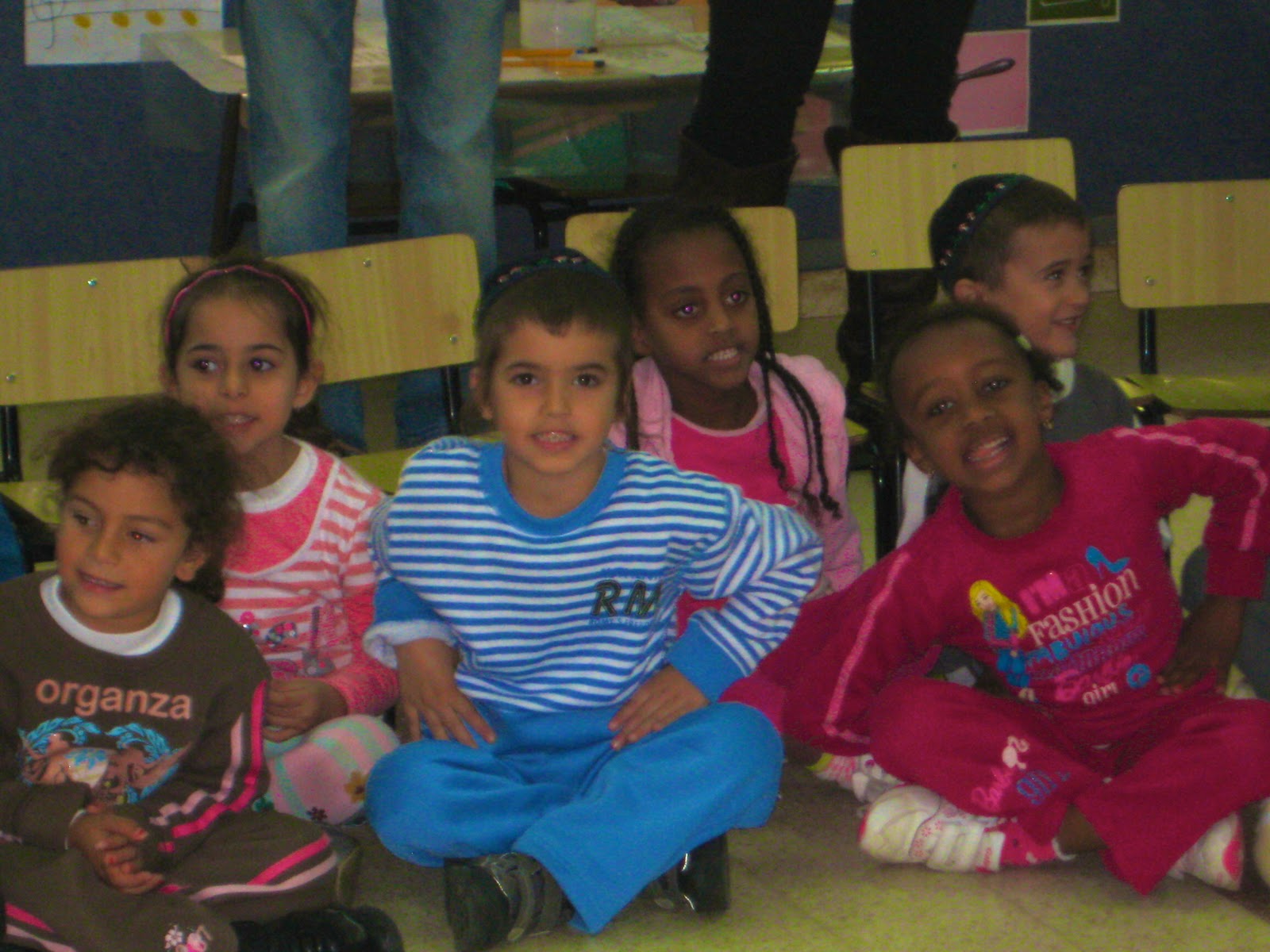
I stepped off the bus and through a bright yellow gate that led to a sunny, colorful courtyard. To my left there were patches of magenta and purple flowers and to my right, beyond the fragmented stone walk I saw half a tire waiting to be jumped on, some bright pink creaky swings, a large plastic truck with oversized wheels, and a cute little table covered with piles of cookies and juice. Through the window of the carefully painted plaster walls I could hear the unmistakable chatter and hum of little voices, happily playing and shouting. As I stepped over the slightly raised frame of the one room building’s door I was greeted by more delighted screams and a quick blur of pink sweatpants chased by a light brown ponytail clipped up by a blue plastic bow. Once all of us had gathered, the thirty or so children broke into such a delightful and cheery song that smiles instantly sprung up in rapid succession throughout our circle of onlookers. They were singing us a greeting and welcome, complete with careful hand motions and tushy shakes. As one little guy twirled his hand in the air on cue he crashed into the chocolate skinned child to his side, causing his little black hat to fall to the floor. With little pudgy hands he quickly swept the embroidered velvet back onto his head and grinned as he spun around. The chocolate skinned child’s smile shone back as they grabbed each other’s shoulders and swayed to the rhythm of the song.  After the song ended to a thunderous applause the children scattered around the room, choosing to either paint, play house, work with clay, eat breakfast, color, or put together a puzzle. A small group were ushered into an adjacent room where they invented their very own life-size game board and began to practice their literacy skills.

The magic of this visit is that I could have been describing either one of the two vibrant, progressive kindergarten programs I had the privilege to visit last week as part of a Next Gen Young Professionals trip organized by JDC. One of the sites was a PACT (Parents and Children Together) room, JDC’s Ethiopian Immigrant program focusing on early childhood education. The other was an ECHAD (Early Childhood Achievement and Development) room, a similar JDC program that focuses on Arab Israeli youth. 

In both these initiatives the goal is one in the same: to provide the best possible academic foundation for EVERY Israeli child. I walked around each room, marveling at displays of creative learning all around. There were interactive centers, paintings and literacy projects on the wall, baskets and baskets of foam, tissue paper, marbles, beads, ribbons, stencils, cones, dice, tops, paper dolls, yearn, buttons, and clay. Learning through music and dance, literacy through song. Hand motions and patterns, firm but very warm educators. In both places I could tell the focus was the child, from their emotions to cultural development to number sense to phonics skills--it was all there. Regardless of language, religion, race, or culture—every child is precious and deserves the same opportunities to grow and blossom. And through these initiatives, whole communities have the chance for a better future because of the education their children are getting. A child is a child is a child, and these wonderful programs are proof of the gains that can be made when one considers the potential of each smiling face.


A morning song from Arab-Israeli Kindergarteners.
A morning song from Ethiopian and Israeli Kindergarteners.


Thursday, November 3, 2011

My First Hebrew Homework

We had to answer a question based on Yossel Birstein's short story "Two Meetings." Below is what I wrote. (Anyone who wants can copy and paste it into google translate and get a rough idea of what I said):

שיעורי בית: מצב שהזמן נעצר


לפני כמה שנים הסבתה שלי הייתה מאד חולה. זה כבר האמשיך שבע שנים. באתי לישראל כדי להיות איתה. ידענו שזה הסוף. כל המשפחה ישב בשקט. חיכינו. אצלנו במשפחה, סבתה שלנו תמיד ידאה בדיוק מה כולם צריכו. היא לא היתה מודעת מספיק כדי לעזור. ישבתי עם סבה בפנים הבית העצוב, השקט, המחכה...ופשוט הייתי. וחיכיתי. בשביל מה? בשביל מתי? פשוט חיכיתי.

בעוד שבוע ידעתי שאני הייתי חייבת לחזור הביתה לעבודה חדשה. ידעתי שאם היא תמות, אני לא תוכל לחזור. בלילה לפני הטיסה חזרתי להטבונן בה עוד פעם אחת. כאשר אמרתי לה שאני אוהבת אתה, כל כך רציתי שהיא תגיב. ידעתי שזה יהיה לשווא. ניגשתי, ליטפתי את פניה, ולחשתי שאני אהבת אתה. שהיא תמיד תהיה בלבי. התחלתי להתרחק, דמעות מצטברות בעיני. היא החזיקה אתם במשך כמה דקות. הרגשתי לרגע היא באמת היתה נוכחת. היא היתה מחזיקה לי את היד חזק, חזק אל לבה. זו היתה הדרך שלה לעשות את זה בפעם האחרונה. במהלך רגע, הזמן עמד מלכת.

בשבוע הבא, היא נפטרה. אני שומרת את הרגע הזה איתי לנצח.

Ashalim: A Safe Haven

The Ma’aleh Room is supposed to be a safe haven for children who are on the sidelines of life. It is supposed to be a place of comfort and belonging, support, uplifting energy, and slow but steady success. The structure is such that each child comes at their designated time to work with a designated staff member who is there just for them, and who will listen to, mentor, tutor, and enrich. Today the director of the room was absent and instead I found myself in a free-for-all of kids wandering in and out at all hours of the day with no one to corroborate their schedules, no knowledge of which volunteers were supposed to be working with who, and who was even supposed to be in the program at all. The worst part is that today, though exacerbated, was not unique.

A small glimpse into what commenced:

N. and I are calmly peering over a recipe in English for Chocolate Coconut Balls. We are crushing the milk biscuits into a fine powder when D. and M. burst into the room, D. sharply throwing an open marker against M.’s chest and each of them retaliating by rushing around the room, forcefully overturning each chair as they go. Of course, N. can no longer concentrate on our English lesson and decides to join them by picking up a pair of scissors and waving it dangerously around. D. and M. stop short when they notice the chocolate.

“Nu, we want to join too?” D. and M. complain in a winy chorus. “What are you making, you whore?” 

I summon my most serious teacher voice (as much as I can muster with a Hebrew vocabulary severely lacking in authoritative commands) and tell them that they may join, but only if they remember that they agreed to treat each other with respect and to pay attention to the lesson. Let’s just say that by the end I found myself rolling balls by myself, surrounded by dusty mountains of spilled cocoa and biscuit crumbs, carelessly torn wrappers, and wads of wet chocolate mix flung onto chairs and tables. When the group came running back from their trip to wash their hands in the bathroom instead of helping me clean up they decided to have a staple gun feud.

And so the day continued.

“What’s that growth on your back, you nerd? Oh, it’s your head, haha!” As H. and I were trying to study for her upcoming English exam by playing a vocabulary game with a deck of cards.

“Aiy! You took me completely by surprise!” L. screamed right into my ear as M. triumphantly pulled her chair out from under her. The vocabulary matching game we were playing ended right then and there.

Bang! All heads turned to see N. thrusting a stack of chairs under the door handle. Bang! Bang! Bang! “Let me in, you creep! I’m going to come to your house and take you by the throat!”

All of them rolling on the floor with laughter as M. waved a long, thin piece of purple clay back and forth in a choice spot that I will leave to your imaginations.

By the end, I left the newly chilled chocolate balls and a supportive note on the table hoping that the boys would eventually show up to celebrate the culmination of their English lesson. I waited for them for half an hour and finally gave up, sulkily saying good-bye to the shnat sherut (year of service) volunteers who were piled together on the sofa watching a video on Utube, and grumpily throwing on my sweater.

After sneaking into a piano room in the Music Community Center next door to the school and writing music with my eyes closed for a good two hours I felt generally better and headed back towards home. On my way, I sat eating my turkey cucumber sandwich and staring out the bus window. The view outside on the windy drive back down from the hills of Gilo is quite breathtaking. Explosions of bright purple, orange, and yellow flowers dotting an otherwise white, rolling landscape. Colorful lines of clothes drying in the light breeze. Trees popping with all kinds of citrus fruits and children chasing each other with flying kites.

I got off the bus to pick up orzo, hazelnuts, and arugula for tomorrow's Shabbat meal and to collect my favorite yellow sweater from the dry cleaners, hoping that the mysterious stains I found on it had been battled out. Everywhere I went people greeted me with a helpful smile and an early Shabbat Shalom. It was a chilly day but the sky was a deep cobalt and the sun was peeking out in warm sprays along the sidewalk. I could smell lemons on the trees and freshly baked bread as I passed and slowly felt the day wash off as I quietly made my way back home. I took a shower and came up with a game plan. And over a steaming bowl of butternut ginger squash soup and some pilfered orzo from tomorrow night's meal, I wrote an e-mail to the director of the program.

Right now, I feel that despite all of our wonderful intentions, the Ma'aleh room's function in reality is the opposite of our lofty goals. Instead of an inviting, comforting space, it is a tornado of curses, punches, running, and too little productivity here and there. Instead of a place to uplift and enrich it has become a hiding place and excuse for not going to class. Instead of banding together a group of children with similar needs and histories who can support and understand each other, it is a forum for threats and disparaging comments. While I haven’t been there since the very very beginning, I’m pretty sure that there was no true introduction. I am going to suggest that we hold a weekly community meeting in the mornings with all of the participants of Ma’aleh to function as a forum for suggestions, opinions, and constructive thinking. 

To begin, I want to hold a formal meeting that establishes norms, introduces the program, and lays out expectations for both the teachers, tutors, volunteers, and pupils alike. I believe that if we take some time to sit together as a group and go over our overall goals and what I used to call giving out “glows and grows” we will not only come closer together as a group but also be able to include everyone in the process. I want to create boundaries and a new environment conducive to the peaceful, warm, inviting safe haven we are supposed to be. I want the children to take ownership of this space and to understand that their success is directly aligned with the effort they put into it. This begins with the formation of a peaceful learning environment. I will suggest that we sit in a circle, make a chart of our ideas, and work together as a community to create the experience we both deserve and need.

In coming up with a solution I have renewed hopes. I sit here thinking about the potential that exists and I am instantly reinvigorated. After all, the only way we can go from here is up.

Saturday, October 29, 2011

ָAshalim: My First Try


These kids are loud, aggressive, impatient, and most of all, they don’t believe in themselves. They come to Ma’aleh to have a place of their own and when they leave, for the most part, they’re back on the margins of society. They’re taller than me, bigger than me, and their Hebrew is rapid-firing, admonishing, and angry. But they’re still children who need the same things that all children do: security, comfort, boundaries, routine, and someone who knows what they can accomplish even when they don’t. I was nervous when I walked in on Thursday morning for my first real day.

 I began with M. Small and covered in scabbed over bruises, M. is a spunky fast-talking kid. He’s always playing with something—a phone, the computer, running from one end of the room to the other. He does everything he can to avoid work. I noticed over the past few days of observing him that he likes clay, markers, and drawing. So I went over to the supply cabinet and took out two pieces of paper, colored pencils, and two scissors. I called him over to a secluded corner and told him that I want to show him something fun. Together, we made two origami fortune tellers and decorated them with words M. is learning in English class. Then we played a game where he had to combine the two words on the flaps of the fortune teller into a sentence in English. Then I would draw it on my paper to create a four-scene comic strip. When it was my turn, I gave him a sentence in English and he had to draw what I said. We sat together for a whole hour and made our story. When we came out, I told him that next week I expect him to retell the stories to me in complete English sentences. He said OK and ran away to sit again in the corner with his phone. Moriah walked over to me startled. She couldn’t believe I got him to sit for an entire hour and learn! He normally doesn’t stay for longer than 15 minutes.

After that, I gained more confidence. I bonded with H., a tall slinky girl with long dark curls swinging down her back and large, thick lashes around her almond shaped eyes. When she told me she loves to dance I entertained her with stories of my six-year-olds in Harlem who think that they’re Michael Jackson and my one student who performed a break-dance routine at the Apollo. We sat in the sun on a light blue bench under an olive tree and completed her English homework. When she left she gave me a quick hug and thanked me and said she’s excited to see me next week.

The day ended with N., the sweet boy who I had watched Moriah counsel the week before. Last Thursday he told me about his plans to go out for pizza and I’d asked him if he’s ever made pizza dough. So he came up to me and asked if I had the recipe yet. I told him I didn’t, but that I would be happy to cook with him every Thursday after school if he agreed to stay a bit later (he has permission to leave school early and this was the only time we had in our schedule for him to work with me). He immediately agreed and we made plans for next week’s first lesson.

I am moving slowly and don’t yet have a plan beyond forming connections. I’m going to take my time and learn each child and then by the end of November I hope to have a project outline for each of them. I’m going to give them a goal of a year-end presentation and then we’re going to get to work, highlighting whatever skills they think will be most useful to present all that they’ve learned. Moriah was excited and asked if I would be willing to work with the other volunteers and give workshops about how to use informal education to support their academics. She asked if I would be willing to do some professional development sessions for the teachers on the thematic projects approach to learning. The best part of the day was when M. and N. ran over to Moriah after only a few hours with them, asked if I would be allowed to join them on their week-long class trip. I don’t have the proper permissions, but the fact that they asked meant I am heading in the right direction.

Thursday, October 27, 2011

Ashalim: The Invisible Child


It is 9 o’clock in the morning and I am sitting in a room full of hope. Piles of books and stacks of games fall against one another on shelves around the room and a large, bent light green stuffed snake threatens to bite me from its perch on the cushion to my side. There are children’s pictures hanging on a bulletin board on the wall filled in by marker. Sponge Bob, Mickey, and Cinderella smile curiously at me from their spots above the schedule of the week. “Shana Tovah” greetings and Sukkot decorations line the periphery of the wall.  One intricately rendered picture stands out from the rest. It is a melting mask, a grotesque face shadowed by navy, pink, and yellow lines. “They’re middle and high school kids,” I remind myself, glancing back and forth between Mickey and the mask.

I am in a meeting with Moriah, the soft-spoken director of the Ma’aleh Room in Tichon Maakef Gilo, a place that promises the invisible child a path to be seen. For the past few weeks, Moriah has been struggling to coordinate with all of the teachers, parents, students, and volunteers to create a perfect schedule that will allow each child all of the support they need. There are 18-year-olds volunteering as their year of National Service before the army and soldiers who were assigned the school as a special job. There are math, Arabic, and history tutors who have signed up to work with individual children. Moriah is a social worker and in charge of creating an inviting atmosphere, managing all of the students cases, keeping track of individual goals, schedules, and needs. Each day I’ve seen her pulled into the hallway to mediate a problem between a student and their teacher or solve a fight between the students. She is pushed and pulled all day long and she hopes I will be able to be her right hand and keep the room running when she is dealing with a disaster.

I will be working here two days a week, providing informal educational and emotional support to a group of five middle schoolers, one-on-one. It is one small room on a sprawling campus serving hundreds of youth in the Gilo area of Jerusalem. We are discussing the backgrounds of each child I will be working with, all ages 13 to 15, all with stories of neglect and lies, constant violence and academic failure. They have spent years in the system, gaining little more than a bitter package of disappointment, ridicule, and lowered self-esteem. My main goal is to show them that there is not only someone who sees them, but someone who also believes in them. I will do this by gaining their trust and then using informal educational activities to support their academic growth. I will try to discover their talents and interests and use them to nurture a project they can succeed in and present proudly at the end of the year.

We are in deep discussion when in a sudden burst of activity the door crashes open and three of the boys in the program tumble in, one yelling at the other that he’s a homo, the other retaliating by swiping his bag and flicking him backhanded on the head. They push and holler at each other for a moment and then settle down onto the dusty couch and begin to play with some clay. Moriah looks up at me and shrugs kindly at the interruption. I tentatively make my way over to the boys, smiling shyly and sitting down next to one as he screams out that there’s nothing to learn in his math class, that his teacher is an idiot and he’s better off throwing some firecrackers at her house. I try to make conversation with the other, but he is absorbed in his game of throwing a ball he has fashioned from the clay back and forth against the wall.

“Now, N.,” Moriah calls,  “you know there is a lot you can learn in that smart head of yours,” She walks over and puts a gentle hand on his shoulder. “Come here, star of mine, I want to talk to you.”

N. shrugs. “There’s nothing to talk about, everything is nonsense.” He mumbles, pulling out an iPhone and instantly beginning to watch an adventure movie. “Whoa, did you see that crazy guy? Whoa, he just jumped across two ceilings!”

“There is plenty to talk about, nu my angel, come over here and sit with me. I want to hear about your weekend.” She ushers him over to a sunlit corner.

N. watches his video for a few more moments and then slinks over to Moriah. She pulls the phone away and slowly, he tells her why he isn’t in class. All his teachers hate him and he is very tired because he went to sleep at two in the morning. He says he doesn’t want to go to class and would rather stay here with us. I watch as Moriah goes and gets a pile of bright colored notebooks and fans them out in front of him.

“I am giving you a notebook and you can choose which one. Did you know that a young man like you needs at least eight hours of sleep to be productive? You can do so much—just think about that 80% you got on your last algebra test! That’s because you worked so hard. But you won’t be able to do it with no sleep, right?” She waits for him to nod. “So I want to make a deal with you that you give yourself enough time for sleep.”

Moriah had already explained to me that there simply isn’t anyone at home to give N. boundaries or rules or generally watch over his well-being. His mother has five other children and was on drugs when he was born. He hasn’t seen his father for three years and thinks that he’s abroad. He’s really in jail. So N. wanders the streets and does whatever he wants when he leaves school.

“I want you to write down when you go to sleep each night in this notebook I am giving you. If you go to sleep at 11pm, then write 11pN. If you go to sleep at 2am, then write 2aN. And don’t come here and lie to me that you went to sleep at 11 if you really went to sleep at 1. That doesn’t help. I’m not interested in lecturing or admonishing you. Don’t be afraid of showing me the notebook if you haven’t been sticking to 11pm, either. That’s OK; I’d rather know what is really happening. That will make me the happiest. Do you understand, my prince?”

She explained that he was to have three goals: to show up to school every day, to try to go to bed on time, and to keep track of how he is feeling each night and anything else he wants to write about when he records his bedtime. Together they would go over what has been happening to him and make new goals.

This is the work of the Ma’aleh room in a nutshell. It is a place to give a voice, comfort, and warmth to the children that only have a silent wall, anger, and cold. This past week I have been fortunate to go visit different sights around the country that JDC-Israel has created, supported, and disseminated. The Ma’aleh program represents a resource room within a school, the Moadoniyot are after-school programs that provide a hot meal, homework support, and enrichment activities, and the Pnimiyot are boarding schools that give all-inclusive care for children whose parents simply are unable to care for them. All of these institutions are headed by a group of social workers, educators, and counselors whose main purpose are to form ties with children who had never had a real family or home before, and eventually to send them back out to society whole. For my small part, I will be working with five children, two days a week. My focus will be English Language support, but through it my goal is to develop a project with each of them that will highlight their interests and strengths, and then they will hopefully learn something along the way. 

The invisible child exists in every country and every culture, regardless of its noble values or lofty goals. Despite our promise to leave no one behind, in spite of our ideas of helping thy neighbor, the invisible child is everywhere to be unseen: wandering through the streets because anywhere else is better than home, sitting in their homes yearning for the one moment their parents will acknowledge their needs, and getting into trouble wherever they go because at least then someone is reacting to what they are doing. I witnessed these realities countless times throughout my years of teaching and now, sitting in this airy happy room, in a high school surrounded by strong tall palm trees, wrapped up in winding white chalk stone, muraled from floor to ceiling with vibrant promises of bright futures—I see it again. But this time despite the insurmountable odds that grow impermeable like a twisted thicket, during my first full week of work I have learned about the picks and hammers that might push through the thorns.

Thursday, October 13, 2011

Learn From Your Fathers and Mothers

"Ahh, how history continues to roll beneath our feet!"

This is what my Saba exclaimed with a shake of his head and a bewildered grin. I have just brought my laptop outside to bask in this perfectly clear, blue sky of a day after one of those incredible moments that just sometimes happen when I visit my Saba's house. I sat down on his black leather couch, leaning against the same pillows I remember from my childhood, and he just began to talk. About the book he's just finished chronicling the life of a man who was one of the founders of Degania, the first kibbutz; about the first chalutzim (pioneers who settled Palestine at the end of the 18th century); about the evolution of the settling of the State of Israel--all the way back to his story, always his incredible, unbelievable, fantastical story.

Every year of my life, we visited the kibbutz, and each time we would sit on Saba's lap to hear "the story." Each year we joked it got longer, but I think his memory just grew as we got older. Today more holes were filled when I asked if he ever read Mein Kampf. He told me this story over lunch (which I paraphrase here):


"We were liberated by black soldiers. Imagine the sight! Me, who has never seen a black man, and them who were witnessing the walking dead. After we were free I decided to return to the village we had passed the day before on the Death March. Me and a boy I had walked with the whole time went and came upon a real house. For the first time in years I walked into a real room with a real bed, with linens and pillows and a shower with soap! I threw off my rags and collapsed into the bed, only after taking my first real shower in years and eating some food. I think I slept for something like 48 hours. Then I dressed and we went back through the village. By the way," he smiled to himself with faraway eyes, "your Savta the first time she saw me asked me what are those silly pants of mine? They were from that house! I told her they were the only ones I had!" He laughed and ate another scrumptious fish pattie. "Suddenly, we saw a library! I couldn't believe my eyes! I rushed inside, as quickly as my weak legs could carry me. I ran to the bookshelf and grabbed at the first book I saw." Here his eyes grew wide and he threw back his head with an excited leap. "And it was Mein Kampf."

I stared at him in awe. "What happened after that?"

"Then at some point I think I must have fainted and someone brought me to the hospital. You know the rest of the story after that."

The rest of this remarkable story is one that I have heard several times, each time renewed. After being taken to the hospital, he lay in a bed with his eyes closed for twenty straight days. The doctor there, who happened to be a man from his own village, Shavli, Lithuania, had known him and his family. He told him he could not believe he was still alive. Then one day, my Saba heard exclamations through the window. Israeli soldiers, from Palestine had arrived in a jeep! Saba threw himself out of bed and rushed to witness this miraculous sight.  He collapsed in front of the soldiers and says that day saved his life.

Years later, my Saba was principal of the school on the kibbutz he founded. He made it a point to visit each of his students, to confer with them and check on the learning environment within the home. He says that's where the real learning starts. He was visiting the parents of one of his students when her father, Naftali, pulled out an album. "You know, " he told my Saba, "I was in a brigade of Israeli soldiers and visited Holocaust survivors in Germany." They realized they had been in the exact same place. And there in the album, was a picture of survivors kissing the soldiers, their jeep, and the flag of Israel. Naftali's daughter ended up marrying my uncle.

And now I'm here in Israel for a year with all of this history rolling beneath my tingling feet.

Me, Saba, and Ima last Pesach